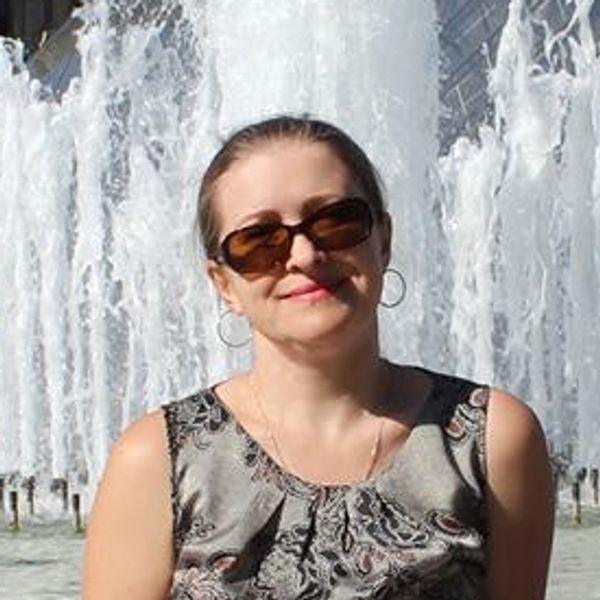
Dr. Valentina Temina-Kingsolver
Founder of Language Avenue · linguist · language teacher
- PhD in Educational Linguistics, University of New Mexico (2015)
- Master's degree in teaching English and German
- Research: formulaic language
Valentina Temina-Kingsolver is a linguist and a language teacher. She founded Language Avenue in 2008 to share good lessons with learners and teachers everywhere, for free, and she still writes and reviews its lessons and articles.
Research
Her doctoral research at the University of New Mexico was on formulaic language: the ready-made chunks of words, such as How’s it going?, by the way or on the other hand, that speakers store and use as whole units. These chunks make up a large part of everyday speech and writing, and they are one reason why fluent speakers sound natural. Her work looks at what counts as a formulaic sequence, how such sequences can be identified, and what this means for learning and teaching a language.
Read more in the section Formulaic Language.
Teaching
Valentina has taught languages for most of her life, to every age group:
- Young children. She founded and ran her own language school, where about a hundred children a year, starting at the age of four or five, learned English through games.
- Teachers. As deputy head for foreign languages at a language school, she led a team of 25 language teachers.
- Teenagers. For fourteen years she taught English language development and English language arts at a middle school in Albuquerque, New Mexico, to English learners and native speakers.
She is also a learner: she is taking a French class right now, which keeps her close to the learner’s side of the desk.
What she believes
The best way to learn a language is to use it with real people.
Rules, word lists and quizzes help, but they are tools. Their job is to give learners the confidence to speak, write and listen to real people. Chunks of formulaic language are one of the most useful tools of all: learn Could you tell me…? as one piece, and you can use it tomorrow.
Articles by Valentina
Formulaic Language
- Criteria for Defining Formulaic Sequences
- Factors Contributing to the Acquisition of Formulaic Sequences in L2
- Formulaic Sequences: Definition Problems
Grammar and Syntax
Language and Thought
- Concept Development in Bilinguals: Vygotskian Framework
- Scientific vs. Spontaneous Concepts: Vygotskian perspective
- Word as a Tool for Scientific Concept Development
Lexical Access
Teaching Writing
She also wrote and edited many of the lessons in Learn English and the classroom ideas in Teach.