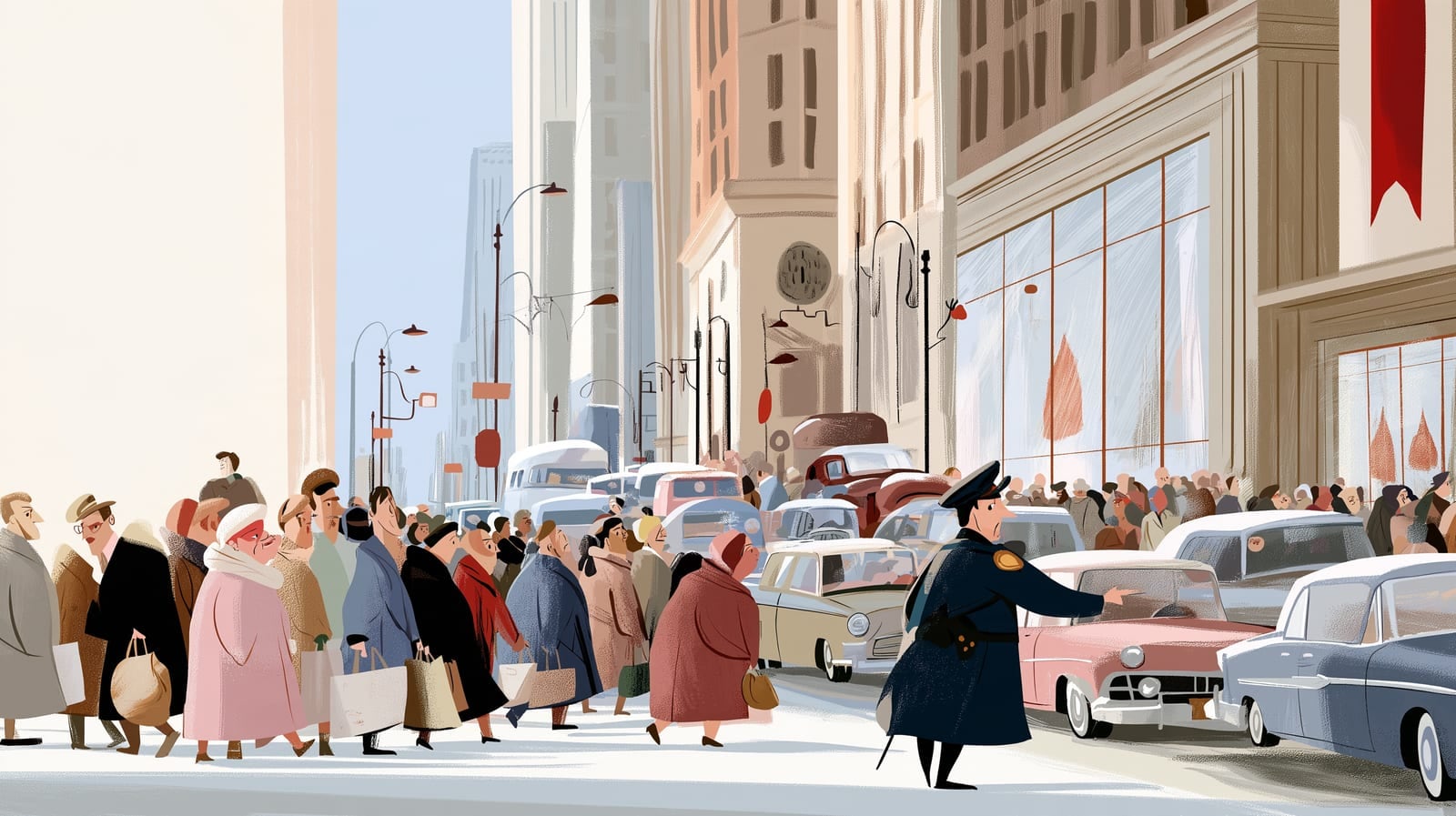
For millions of Americans, the day after Thanksgiving is not a day of rest. Long before sunrise, line up outside stores in the cold, hoping to be among the first through the doors when the sales begin. This is Black Friday, the unofficial start of the holiday shopping season, and today it is copied in countries from Brazil to India. But why would anyone choose such a dark name for a day of ?
A name with a bad reputation
In English, “black” days have rarely been good ones. Black Tuesday was the stock market crash of October 1929; Black Monday was another crash, in October 1987. The first famous Black Friday had nothing to do with shopping either. On September 24, 1869, two investors, Jay Gould and James Fisk, tried to buy up so much gold that they could control its price. When the government released its own gold, the price collapsed in a matter of minutes, and the ruined thousands of people.
Traffic jams in Philadelphia
The shopping meaning was born almost a century later, on the streets of Philadelphia. In the 1950s and 1960s, the city’s police officers dreaded the day after Thanksgiving. Suburban shoppers poured into the city center, and on Saturday the famous Army–Navy football game brought even more visitors. Officers had to work long shifts in the of traffic and crowds, and they gave the day a of their own: Black Friday. Store owners hated the name and tried to replace it with “Big Friday,” but it was too late. By the 1960s it was appearing in print, and it slowly across the country.
From red to black
Many people today will tell you a different story. Businesses used to keep their accounts by hand, writing losses in red ink and in black. According to this explanation, many were “” for most of the year and only moved “” when the holiday shopping began. It is a neat explanation, and the idioms are real, but historians point out that it appeared only in the 1980s, long after the police had named the day. The positive story was useful to stores, so it stuck.
A holiday moved for shoppers
Black Friday was so important to business that it once changed the date of Thanksgiving itself. In 1939, Thanksgiving was due to fall on the last day of November, which left a very short shopping season before Christmas. President Franklin D. Roosevelt moved the holiday one week earlier to give stores more time to sell. Critics mocked it as “Franksgiving,” and for two years Americans celebrated on different dates in different states. In 1941, Congress settled the matter: Thanksgiving would always be the fourth Thursday of November.
Doorbusters and a long weekend
In the following decades, stores competed to open earlier and earlier. They advertised “,” products sold at a huge to pull bargain hunters through the doors, sometimes in very small numbers. The crowds could turn into a , and some years people were injured in the rush. Opening times moved to midnight and then to Thanksgiving evening itself, which caused a from workers and customers who felt the holiday was being lost.
Meanwhile, the weekend grew. In 2005, an online retail group the term Cyber Monday for the online sales that follow Black Friday. Small Business Saturday, created in 2010, asks people to buy from local shops, and Giving Tuesday, started in 2012, encourages to charity. There is even a protest: Buy Nothing Day, started in Canada in 1992, asks to spend nothing at all.
The language of the sales
Black Friday has given English a small vocabulary of its own. A is a moment of wild, excited activity, and newspapers love to describe a “shopping frenzy.” People when they spend more than they planned, and they when they compare prices before they buy. And when a store finally reaches its yearly profit, it is in the black, whatever the true history of the name.
So the next time you see a “Black Friday” sale, remember that the name began with a gold crash and a traffic jam, not with a celebration. Words, like prices, can change a great deal over time.
Study the Words
20 new words from the story. Click the speaker to hear each one.
Part 1: Words to learn first (B2)
- shopper/ˈʃɑpər/a person who is buying things in shops
- bargain/ˈbɑrɡɪn/an agreement about buying or selling something
- discount/ˈdɪskaʊnt/an amount taken off the usual price
- profit/ˈprɑfɪt/money a business makes after it pays its costs
- retailer/ˈriːteɪlər/a business that sells things to the public in shops or online
- consumer/kənˈsuːmər/a person who buys and uses products
- nickname/ˈnɪkneɪm/an informal name for a person, place or thing
- chaos/ˈkeɪɑs/a state of complete confusion and disorder
- to spread/spred/to reach more and more places or people
- donation/doʊˈneɪʃən/money or things you give to help people
Part 2: Harder words (C1 and up)
- panic/ˈpænɪk/a sudden fear that makes many people act quickly and without thinking
- in the red/ɪn ðə ˈred/losing money; owing more than you have
- in the black/ɪn ðə ˈblæk/making money; not in debt
- doorbuster/ˈdɔrˌbʌstər/a very cheap sale item that brings crowds into a store when it opens
- stampede/stæmˈpiːd/a sudden rush of a big crowd in one direction
- backlash/ˈbæklæʃ/a strong negative reaction from many people
- to coin/kɔɪn/a small, round piece of metal money
- frenzy/ˈfrenzi/a moment of wild, excited activity
- to splurge/splɝdʒ/to spend a lot of money on something you enjoy
- to shop around/ʃɑp əˈraʊnd/to compare prices in different shops before you buy