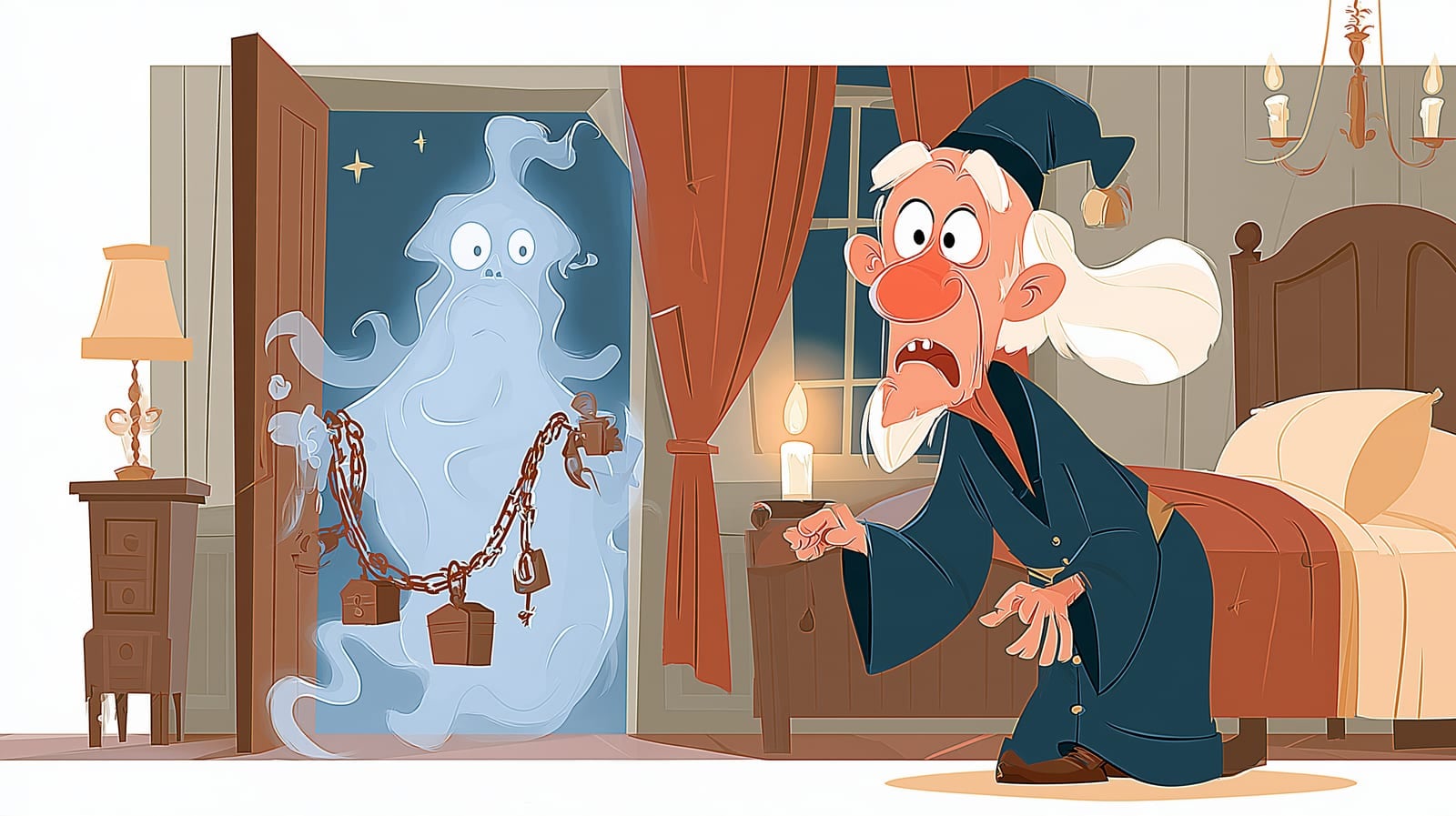
Part 1: Marley’s Ghost
Ebenezer Scrooge was the hardest man in all of London. He was a : he loved money more than anything, and he hated to spend it. He was cold inside and out. Nobody ever stopped him in the street to say, “How are you, Mr. Scrooge?” Even dogs pulled their owners away when he came near.
Seven years ago, his business partner, Jacob Marley, had died on Christmas Eve. Since then, Scrooge had run the business alone, and he was as as ever.
It was Christmas Eve again, cold and foggy. Scrooge sat in his office, counting money. In a small, freezing room next to his, his , Bob Cratchit, was copying letters. He had only one tiny coal fire, and Scrooge would not give him any more coal.
The door opened, and Scrooge’s cheerful young , Fred, came in. “Merry Christmas, Uncle!” he cried. “Come and have Christmas dinner with us tomorrow!”
“Christmas! !” said Scrooge. “What is Christmas but a time for paying bills without money? Good afternoon!”
Fred left, still smiling. Then two gentlemen came in. They were collecting money for , to buy food and warm clothes for the poor at Christmas.
“Are there no prisons?” asked Scrooge. “Are there no ? Let the poor go there.”
“Many can’t go there, and many would rather die,” said one of the gentlemen.
“If they would rather die,” said Scrooge, “they had better do it, and reduce the surplus population. Good afternoon, gentlemen!”
At the end of the day, Bob Cratchit asked for Christmas Day off. Scrooge agreed, very unhappily: “But be here all the earlier the next morning!”
Scrooge went home to his big, dark, house. As he put his key in the door, he saw something strange: the on the door had become the face of Jacob Marley. He looked again, and it was a knocker once more.
Later, as Scrooge sat by his small fire, a bell began to ring, then all the bells in the house. He heard heavy steps on the stairs and the sound of . Through the closed door came the of Jacob Marley. Long, heavy chains of cash boxes, keys and money bags were wrapped around his body.
“Why are you in chains?” asked Scrooge, .
“I wear the chain I made in life,” said the ghost. “I made it link by link, with every selfish day. Your chain was as long as this seven years ago, Ebenezer, and you have worked on it ever since. I am here to you. You still have a chance. Three spirits will visit you.”
Then the ghost flew out of the window into the night, and Scrooge fell into bed without even taking off his clothes.
Part 2: The Spirits of Christmas Past and Present
At one o’clock, a strange light filled the room. By the bed stood a spirit like a child and an old man at the same time, with a bright light shining from its head. “I am the Ghost of Christmas Past,” it said. “Your past.”
The spirit took Scrooge’s hand, and they flew through the wall. Suddenly they were standing on a country road on a clear winter day. Scrooge saw his old school, almost empty for the holidays, and a lonely boy reading by a weak fire. “That is me,” he said quietly, and a tear ran down his face.
Then he saw himself as a young man, working for kind old Mr. Fezziwig. Every Christmas Eve, Fezziwig closed the shop early and gave a party with music and dancing for everyone. “He made us so happy,” said Scrooge, “and it cost him so little.” He thought of Bob Cratchit, and he felt something strange: regret.
Last, he saw a young woman named Belle. She had once loved him. “Another idol has taken my place,” she told the young Scrooge. “A golden one. You love money more than me.” And she left him. “Spirit,” Scrooge cried, “show me no more!”
Then he was in his own bed again. When the bell struck two, a voice called him into the next room. The room was full of green branches and light, and the floor was piled high with turkeys, cakes, fruit and roasted chestnuts: a Christmas . On top sat a happy giant. “I am the Ghost of Christmas Present,” he said. “Touch my robe!”
They visited the streets of London, where poor families carried their dinners to the bakers’ ovens and wished each other Merry Christmas. Then they came to Bob Cratchit’s tiny house. The family was poor, but full of love. Mrs. Cratchit and the children were preparing a small goose. Bob came home carrying his youngest son, Tiny Tim, on his shoulder. Tim was a sweet, small boy who walked with a .
At dinner, Tim said, “God bless us, every one!”
“Spirit,” said Scrooge, “tell me if Tiny Tim will live.”
“I see an empty seat by the fire,” said the ghost, “and a crutch without an owner. If nothing changes, the child will die.” Then he used Scrooge’s own words: “If he is going to die, he had better do it, and reduce the surplus population.” Scrooge felt deeply ashamed.
Then they visited Fred’s house, where friends were laughing and playing games. Fred raised his glass: “To Uncle Scrooge! He won’t have it from me, but I wish him a Merry Christmas anyway.”
Part 3: The Spirit of Christmas Yet to Come
The last spirit came silently, like a dark fog. It wore a long black robe, and Scrooge could see only one hand. It did not speak. It only pointed.
“Ghost of the Future,” said Scrooge, “I fear you more than any of the others. But I know you want to help me. Lead on!”
The spirit showed him businessmen in the street, laughing about a man who had just died. “It will be a very cheap funeral,” said one. “I don’t know anybody who will go to it.” In a dirty shop, poor people were selling the dead man’s things, even the curtains from his bed. Nobody was sad that he was dead.
Then the spirit took him to the Cratchits’ house. It was quiet. The children sat still, and Mrs. Cratchit was sewing. Bob came home and sat in the corner. Tiny Tim’s little crutch stood by the fireplace. Tim was gone.
At last, the spirit took Scrooge to a cold, lonely churchyard and pointed to an old, forgotten grave. Scrooge walked to it, shaking, and read the name on the : EBENEZER SCROOGE.
“No, Spirit! No!” he cried, falling to his knees. “I am not the man I was! I will honor Christmas in my heart and try to keep it all the year. I will live in the Past, the Present and the Future. Tell me I can change these shadows!”
He caught the spirit’s hand, and the dark robe fell into a pile … and became his own bedpost.
He was in his own bed, in his own room. The sun was shining. He ran to the window and called to a boy in the street. “What day is today?”
“Today? Why, it’s Christmas Day!”
“I haven’t missed it!” laughed Scrooge. He sent the boy to buy the biggest turkey in the shop, and he sent it to Bob Cratchit’s house, without saying who it was from. In the street, he found one of the gentlemen from the charity and promised him a very large sum of money. Then he went to Fred’s house for Christmas dinner, and everyone was amazed at how and kind he was.
The next morning, Bob Cratchit came to work eighteen minutes late. “What do you mean by coming in at this time of day?” said Scrooge in his old voice. Then he smiled. “I am going to raise your salary, Bob, and help your family!”
Scrooge kept his word. He became a second father to Tiny Tim, who did NOT die. He became as good a friend, as good a master and as good a man as the good old city knew. He was to everyone, and people said that he knew how to keep Christmas well. And as Tiny Tim said, “God bless us, every one!”
Study the Words
18 new words from the story. Click the speaker to hear each one.
Part 1: Words to learn first (B1–B2)
- miser/ˈmaɪzər/a person who loves money and hates to spend it
- greedy/ˈɡriːdi/wanting more money or things than you need
- clerk/klɜːrk/a person who works in an office, writing letters and keeping records
- nephew/ˈnefjuː/the son of your brother or sister
- charity/ˈtʃerɪti/money or help that you give to poor people
- ghost/ɡoʊst/the spirit of a dead person that some people believe they can see
- chain/tʃeɪn/a line of small metal rings joined together
- to warn/wɔrn/to tell someone that something bad may happen
- feast/fiːst/a large, special meal for many people
- cheerful/ˈtʃɪrfəl/happy and full of good feelings
- generous/ˈdʒenərəs/happy to give money, time or help to other people
Part 2: Harder words (C1 and up)
- humbug/ˈhʌmˌbʌɡ/an old word for nonsense, something silly and not true
- workhouse/ˈwɝkˌhaʊs/in old England, a hard, unkind place where very poor people lived and worked
- gloomy/ˈɡluːmi/dark and sad
- knocker/ˈnɑkər/a metal ring on a front door that you hit against the door
- to shiver/ˈʃɪvər/to shake because you are cold or afraid
- crutch/krʌtʃ/a long stick that helps a person with a bad leg to walk
- tombstone/ˈtuːmˌstoʊn/a stone on a grave with the name of the dead person